Bulletin – 2nd Weekend in Ordinary Time

Dear Friends,

We meet this weekend on Saturday at 4:30 P.M. to reflect and pray over our God’s great love for us in the context of a wedding feast. Weddings in the best sense are about love freely given, deep trust in another human being’s willingness to say “yes” to life and love together as long as the two shall live.  Our God’s love for each of us is just that intense, that true. Come; celebrate and pray with us this Saturday.

Peace and love,

Pastor Kathy

P.S.  Think about whether you would like to have pot-luck suppers during Lent, February 20 and March 19. March 19, Saturday will be our celebration of Palm Sunday.  Get back to me with your wishes. 


Readings: 

  • Isaiah 62: 1-5
  • 1 Corinthians 12: 4-11
  • John 2: 1-12

Homily – Baptism of Jesus

My friends, as you can see, the Church Year, with the readings for this week, has taken a major leap forward.  We are not at the crib anymore, but are suddenly thrust into the public life of our brother Jesus.  The seeming bliss of the crib, even with its ardors, is over, and now; we find Jesus on the brink of all that his Abba has called him to—his reason for becoming Emmanuel-God-with-us.

The overriding theme of the Christmas Season has been hope—a hope that with new life; change, goodness and renewed love and compassion for all, is possible. Whenever new life comes to us; we instinctively feel this hope.  Symbols like the star, shedding light in the darkness of our seeming chaos are comfort for our souls so in need of that comfort amid wars raging around our world, amid so much death and suffering in our country—lives unmercifully taken out of fear and mental illness and so much of it due to a proliferation of guns in the hands of our people.   Hope springs eternal that as we move from the crib in Bethlehem to the waters of the Jordan, that new life is possible.

In order for us to understand the true significance of Jesus’ baptism, it is good to look at what John’s baptism “of repentance for the forgiveness of sins” was really all about.   It was a different experience for Jesus, than for the others who came to John. We believe Jesus to have been without sin, so why would he subject himself to this ritual of cleansing that made sense to the common people who were accustomed to ritual cleansings and the symbolic inner value that it represented?

We perhaps make the event too simple as well as Jesus’ entire human life if we simply label him, “without sin.”  If we in fact do this, do we not take his humanity away?  To be human means that we are imperfect by nature—we are susceptible to that which isn’t perfect.  The true gift of Jesus our brother was that he took on our humanity, our imperfection, to show us the way to live an imperfect existence, perfectly.  So, it was necessary to immerse himself in our life completely, to step down, as it were, written about so beautifully by Paul in his letter to the Philippians, chapter 2—“His state was divine, yet he did not cling to it.”

It has been suggested that he also took this opportunity to receive divine affirmation for his messianic mission.  We hear—“this is my Beloved, on you my favor rests!”  Just as Mary perhaps needed Elizabeth’s affirmation that the Child she carried was indeed who the angel said he would be—“Who am I that the mother of my God should visit me?”  The voice from heaven that we hear about in the Scriptures today was an ancient Israelite way of referring to divine communication.

So we see the stage is being set for our brother Jesus, one perfectly “with us” taking on our existence in its entirety, complete with all the joys, sufferings and frustrations and when he comes out of the water, Jesus is fully ready as servant, prophet and priest to bring justice to the nations, to open the eyes of the blind, to bring out prisoners from confinement, as Isaiah has so beautifully described the role of the servant/Messiah for us today.

This description, read today from Isaiah, of what it is to be a servant is a wonderful definition and call to each of us as baptized Christians to move among God’s people doing what we can, what we must, to make sure that Jesus’ justice—God’s justice, is there for all. Bringing justice is what Isaiah’s servant does—nothing less.  So how do we do this we might ask?  A prime example this next year comes for each of us as we prepare to vote in national elections for new leadership. We have a responsibility to vote for those candidates who will bring the most justice to the least among us.  We reach out of our comfort and help where we can, whenever we can.  The psalmist prays today, “Our God will bless the people with peace—our gift, my friends, for being servants. The evangelist Luke, in the reading from Acts today, reminds us that “Jesus went about doing good works and healing all who were in the grip of the Devil.”  Our brother Jesus calls us likewise to be our best selves—bringing peace, not chaos into peoples’ lives. In addition, welcome should always be on our lips, to invite, to include more—everyone in fact, in God’s love.

With that in mind, I would like to invite once again, as in the past, for each of you to take one of my cards and in your wanderings throughout the next weeks, invite someone who may be without a church family, or frustrated with where they are, to come and be with us.  And don’t worry what people do or say—we, each of us merely need to invite, to welcome, and the Spirit will take it from there.

If we look at Jesus’ life, we see too that there was much chaos to deal with, but if he has asked us to continue his work—to be his hands, eyes, ears and heart for the world, then we can be equally sure that we will not be left alone.  I take great hope from Jesus’ promise, before he physically left us, that, he would be with us always—we shouldn’t be afraid.

So, my friends, Christmas is over—we can’t continue to look back at the babe in Bethlehem, the innocent, sweet child;  but we must move forward now with the adult Jesus who is calling each of us to be the change our world so badly needs. Today calls each of us to consider our own baptisms and what that action ultimately means in our lives. Most of us were baptized as infants, a gift our parents gave us.  Now, as adults, as followers of our brother Jesus, we can no longer be complacent as when we were infants. In the words of my friend, Fr. Paul Nelson, “We are called to dignity, to rise above excuses in life, to engage our best selves.” Amen? Amen!


News Item

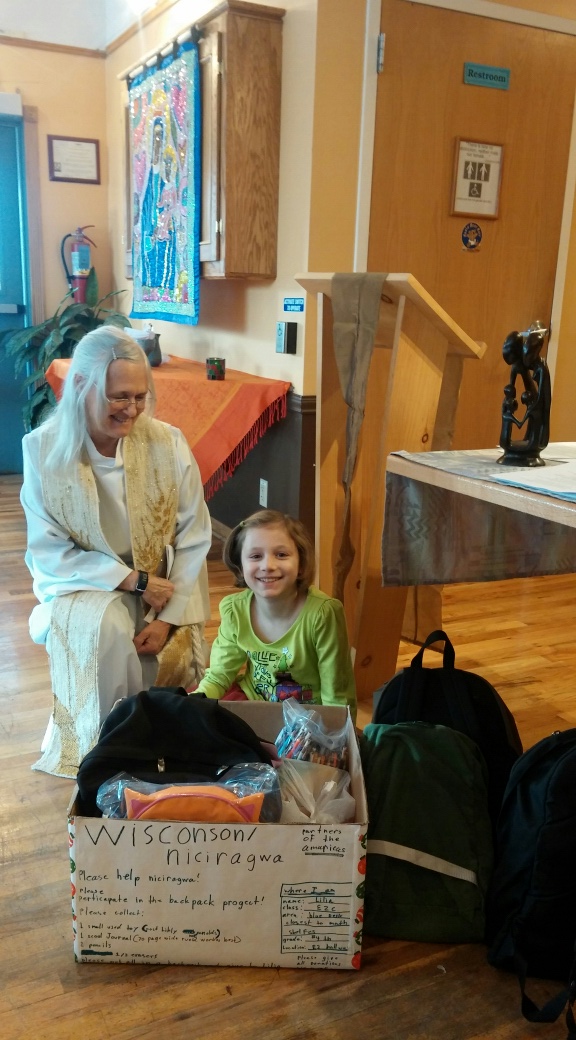
Lilia Civettini attended Mass recently to pick up the school supplies that All Are One Catholic church collected to assist her in her backpack project for children in Nicaragua. She was really pleased to receive our donations. Later on we added some small stuffed toys so that each child would receive a toy along with their school supplies. Our parish wanted to help Lilia because we were so impressed that a nine-year old would be concerned enough to reach out to others in this generous way. lilia pic-1

Bulletin – Baptism of Jesus

Dear Friends,

This Sunday’s liturgy, The Baptism of Jesus, calls us to reflect on what baptism meant to him at the beginning of his public ministry and likewise calls us to reflect on our own baptisms and what that initial blessing as infants, for most of us, means to us, today.  Does that fact make a difference in how we live our lives each day?

Come; ponder these questions with us.

Peace and love,

Pastor Kathy


Readings:

  • Isaiah 42: 1-4, 6-7
  • Acts 10 : 34-38
  • Luke 3: 15-16, 22


Note: We are looking for people willing to serve on our board–please let the pastor know of your willingness to put your name on the ballot by Sunday evening, January 10, 2016.  Thank you.  aaorcc2008@gmail.com.


Homily – Epiphany


My friends, today in a somewhat “official” way we remember the coming of astrologers from the East—those men purported to have studied the stars—the heavens, and in that profession discovered a star so different, so amazing really, that they were willing to follow its light wherever it led.  The thinking at that time was that a “new light” in the heavens correlated with an equivalent happening on earth.  The actual day on the Church calendar for this feast is January 6th, the 12th day of Christmastide, but in order to celebrate this “manifestation” well, which is what “epiphany” means, the feast usually falls on the first Sunday in the New Year unless that happens to be January 1, then other feasts take precedence, Marian feasts and days of peace.

In faith, in relation to the words of prophets of old that a messiah would come, would be born of a virgin, would be One who would change the course of everything; we believe that Jesus, our brother is this One who fulfilled the prophecies of old.  Not only that, but he tied the heavens above to the earth below in a way so wonderful that indeed those who studied those same heavens would travel for weeks to discover what magnificent event on earth was so clear a response to this great light in the sky.

The coming of the Magi is only recorded in the gospel of Matthew and we can’t be sure of its truth, especially in detail, like whether for instance, there were three kings—astrologers—or more.  The number three seems to have come from the fact of the three  gifts named, gold, frankincense and myrrh—one gift in the hands of each king.

We might wonder why these gifts were given—what was their significance.   Because there seems to have been a correlation between a great “showing” in the heavens and a likewise great “showing” on earth, as mentioned earlier, it is clear that these men who were of some import themselves, saw the birth of Jesus as the birth of a king and the gifts given signified that.  These gifts were valuable; gold as a precious metal, then and now, frankincense as a perfume or incense and myrrh as an anointing oil.  We are told that these same three items were apparently among the gifts that ancient kings offered to the god, Apollo.

In this story, as in much that we read in the pages of the Bible; we realize that the stories aren’t meant to be taken literally, that almost always, something greater, is afoot. In this case, as mentioned already, “epiphany” means “manifestation”—a showing forth.  The coming of those interested, the Magi, of those encouraged to “go and see,” the shepherds, this wonderful event that had taken place in Bethlehem does not need to be word-for-word, correct—the greater message that we need to take away is that people did, come to see, were encouraged “to go and see” and for each, there was no doubt, a bit different manifestation. God works in each of our lives in different ways. Our God looks at who we are, where we are in our life’s journey, what has happened along that journey, and then speaks to us in ways that we can understand. Our God also challenges us to get beyond our own experiences to see the experiences of others.

In the case of the Magi, possible kings and those who had studied; they came seeking a “king,” and no doubt were troubled in finding “one who would be king” in fact, born in a stable.  They may have needed to come to a deeper understanding of purposes in the larger world that were greater than what meets the eye—not in glory, but in poverty. We get the sense from all the extended writings about these astrologers, that they were used by God to instruct the new parents, Mary and Joseph, about coming dangers.

The Scriptures don’t tell us much about the “Three Kings” other than what Matthew, the evangelist has left us—they evidently showed up at the first Christmas, went back home and were never heard from again.  Those who have done more study on these matters tell us that the Magi went home, shared the story of Jesus, wherever home was, and that they were later baptized by the apostle Thomas who was a missionary to India.

So my friends, what does all this mean for us today? Why celebrate a day that remembers the coming of well-to-do strangers?  Much as our brother Jesus did in his earthly life among us, telling us, showing us manifestations of a God bigger than what we could see at face value; the coming of these wise ones from the East then, and now (think refugees) are ways that our God can show us more.

The Magi found something, Someone in Bethlehem different than they thought they would find. The real manifestation for them was that God came to earth in the form of the poorest among us so that our eyes would be opened to go into our world and find God too in the poorest to the richest, but never to forget the poorest.  Not in glory, but in poverty. It is good to remember who it was who was told of the baby in Bethlehem—the shepherds—the poor, not King Herod or the powers-that-be in Bethlehem.

My friends, the message we must take away from this feast, and the end of the 12 days of Christmas on January 6th is that the message of love which is Christmas is for all days, for all people, not just the twelve we set aside to officially celebrate this winter-time-here, season of joy. This is Paul’s message to us today in his letter to the Ephesians.

Christmas is about the miracle born in a stable over 2,000 years ago.  Jesus is sign and symbol of the miracle that each person born is and he called attention to that in choosing to be one-of-us, not in glory, but in poverty to raise each of us to the greatness that we are called to be.  Christmas time has only worked its magic on us if we in fact allow the love of that first manifestation of love to be manifested each day through our lives. Teilhard de Chardin said it this way: “A universal love is not only psychologically possible; it is the only complete and final way in which we are able to love.”

So, you see, it doesn’t really matter, how many kings came, whether in fact they came at all—what matters, as always, is the greater message—love was manifested in Jesus of Nazareth as a poor baby in a stable and we then must manifest that same love as we meet our world, each and every day of our lives!

So today, as we begin a new year in our world and Church, even though there is much that still needs our care, and we can all name the issues, let us carry away two pieces of wisdom—first from Meister Eckhart:

“Only [the one] to whom God is present in everything and who employs reason in the highest degree and has enjoyment in it knows anything of true peace…” –this bit to challenge us in this new year and finally, to give us hope, words from the Desiderata:

“You are a child of the Universe, no less than the trees and the stars…whether or not it’s clear to you…the Universe is unfolding as it should…it still is a beautiful world.” Amen? Amen!